

The 2026 NFL season is producing a striking split in the U.S. betting market. Traditional regulated sportsbooks are still handling billions of dollars in wagers, but the growth that once defined the legal sports-betting expansion has slowed just as prediction markets have begun attracting enormous trading volumes. For bettors comparing traditional sportsbook options, the BetAnySports reduced juice review also highlights how lower-vig alternatives remain part of the broader competition for NFL wagering dollars.
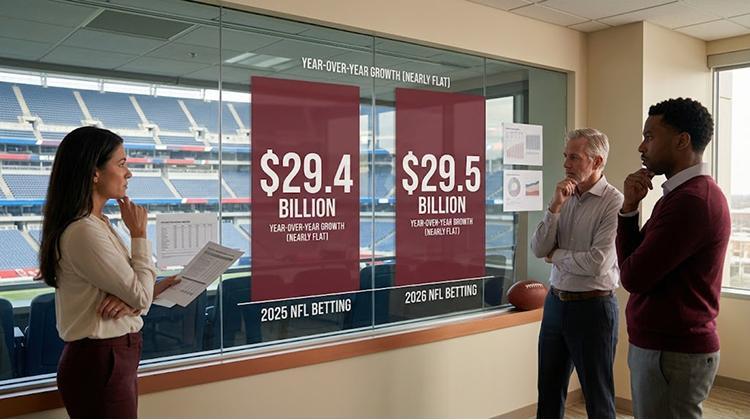
The American Gaming Association (AGA) estimates Americans will legally wager $29.5 billion on the 2026 NFL season through commercial sportsbooks regulated by U.S. states and tribal jurisdictions. That would represent almost no growth from the estimated $29.4 billion wagered during the 2025 NFL season.
The number itself is remarkable because the legal U.S. sports-betting market spent years expanding as more states launched online sportsbooks. But the 2026 projection arrives at a different moment. Platforms such as Kalshi and Polymarket are offering sports-related prediction contracts nationwide, while major sportsbook brands including DraftKings and FanDuel are developing their own prediction-market products.
The result is a more complicated competitive environment for the traditional sportsbook industry. The question is no longer simply how much Americans will bet on the NFL. It is increasingly about where that money will be placed and whether a traditional sportsbook remains the preferred destination for NFL bettors.
The $29.5 Billion NFL Betting Plateau
The AGA released its 2026 NFL wagering projection on September 4, estimating that legal commercial sportsbooks would handle $29.5 billion across the season. Its estimate includes preseason games, futures wagers placed as early as March, the playoffs and Super Bowl LXI in February 2027.
That figure represents a dramatic change from the industry’s earlier growth pattern.
Legal sports betting expanded rapidly after the U.S. Supreme Court struck down the federal Professional and Amateur Sports Protection Act in 2018. States subsequently established their own regulatory systems, allowing sportsbooks such as DraftKings, FanDuel, BetMGM, Caesars and Bet365 to build large customer bases.
By 2026, however, much of the state-by-state expansion has already occurred. The AGA says commercial sports betting is legal in 40 jurisdictions, while 11 states continue to prohibit it. That leaves less room for the traditional sportsbook market to grow simply by adding new states.
The $29.5 billion projection therefore matters beyond the headline figure. A nearly unchanged handle suggests that the established market may be entering a more mature phase at exactly the moment another betting ecosystem is expanding.
For bettors, that means the distinction between a sportsbook wager and a prediction-market contract is becoming increasingly relevant.
Prediction Markets Are Already Generating Billions
The strongest evidence of the shift arrived during the opening weekend of the 2026 NFL season.
According to Reuters reporting based on a Jefferies analyst note, eight major prediction-market platforms generated $3.12 billion in trading volume on the first Sunday of the NFL season. That followed another $3.17 billion in prediction-market volume on Saturday, when college football was a major driver.
Kalshi was particularly active.
The platform generated $4.89 billion in volume across the weekend, including more than $590 million in individual Week 1 NFL contracts. Kalshi also recorded a new daily volume record of $2.433 billion on Sunday.
One individual NFL matchup demonstrated how quickly these markets can attract trading activity. The Dallas Cowboys–New York Giants primetime game generated approximately $112.8 million in Kalshi volume. The Minnesota Vikings–Green Bay Packers matchup generated another $39.6 million, while the New York Jets–Tennessee Titans game produced about $8.4 million.
Polymarket also recorded substantial activity, although its Sunday volume of approximately $404 million was considerably below Kalshi’s total.
These numbers do not represent the same thing as traditional sportsbook handle, and they should not simply be added together. Prediction-market volume reflects trading activity in contracts, meaning the same contract can potentially change hands multiple times.

Still, the figures demonstrate something important: major NFL games have become significant events inside prediction markets, not merely traditional sportsbooks.
NFL Betting Is Growing While The Market Around It Changes
Traditional sportsbook activity has not disappeared.
GeoComply recorded 99.8 million geolocation checks on the Sunday of NFL Week 1, according to Legal Sports Report. That represented a 176% increase from two weeks earlier. New sportsbook account registrations also increased more than 310% to approximately 135,700.
That data creates a more nuanced picture than the $29.5 billion projection might initially suggest.
NFL betting remains enormously popular. The issue is that the overall betting economy is becoming more competitive.
Legal sportsbooks are fighting for established customers while prediction markets attempt to capture users with a different product structure. Traditional sportsbooks generally offer fixed odds on outcomes, while prediction markets allow customers to buy or sell contracts whose prices fluctuate according to perceived probabilities.
For a bettor, a traditional moneyline might offer a fixed price on a team. A prediction market can instead present a contract that trades at a changing price as the market reacts to news, injuries, game action or other information.
That distinction can make the experience feel closer to financial-market trading than conventional sports wagering.
The competition is becoming even more significant because some of the industry’s biggest companies are participating directly.
DraftKings And FanDuel Are Moving Into Prediction Markets
Prediction markets are no longer limited to independent platforms.
DraftKings and FanDuel have both developed prediction-market products, adding another layer to the competitive battle. Legal Sports Report reported in September that DraftKings Predictions and FanDuel Predicts allow users to trade event contracts using a structure that differs from traditional sportsbook betting.
The strategy makes commercial sense for major sportsbook operators.
DraftKings and FanDuel already have millions of sports users, established brands and significant customer-acquisition infrastructure. Moving into prediction markets allows them to compete in a category that is attracting attention without abandoning the sports audience they have spent years building.
Fanatics is taking a similar approach. CEO Michael Rubin said the company could spend as much as $1 billion on advertising in 2027 as it attempts to close the gap with DraftKings and FanDuel. Fanatics has also entered prediction markets through Fanatics Markets.
The spending race matters because customer acquisition has become one of the defining battles of the U.S. sportsbook industry.
If prediction markets continue attracting NFL bettors, traditional operators may have to compete on two fronts: conventional sportsbook products and a new category of event-based contracts.
Regulation Could Decide Who Wins
The biggest uncertainty surrounding prediction markets is not consumer demand. It is regulation.
States and prediction-market operators disagree fundamentally over whether sports-related event contracts should be treated as financial derivatives under federal law or as gambling products subject to state gaming regulations.
The conflict has already reached courts across the country.
On September 24, New York Attorney General Letitia James sued Polymarket, arguing that its operations violated state gambling laws. Polymarket responded with a federal lawsuit arguing that the Commodity Futures Trading Commission has exclusive authority over its prediction-market activities.
New York’s case illustrates why the issue matters to traditional sportsbooks.
Licensed sportsbooks operate under state-specific rules covering age restrictions, responsible-gambling programs, taxation, advertising and other consumer protections. Prediction